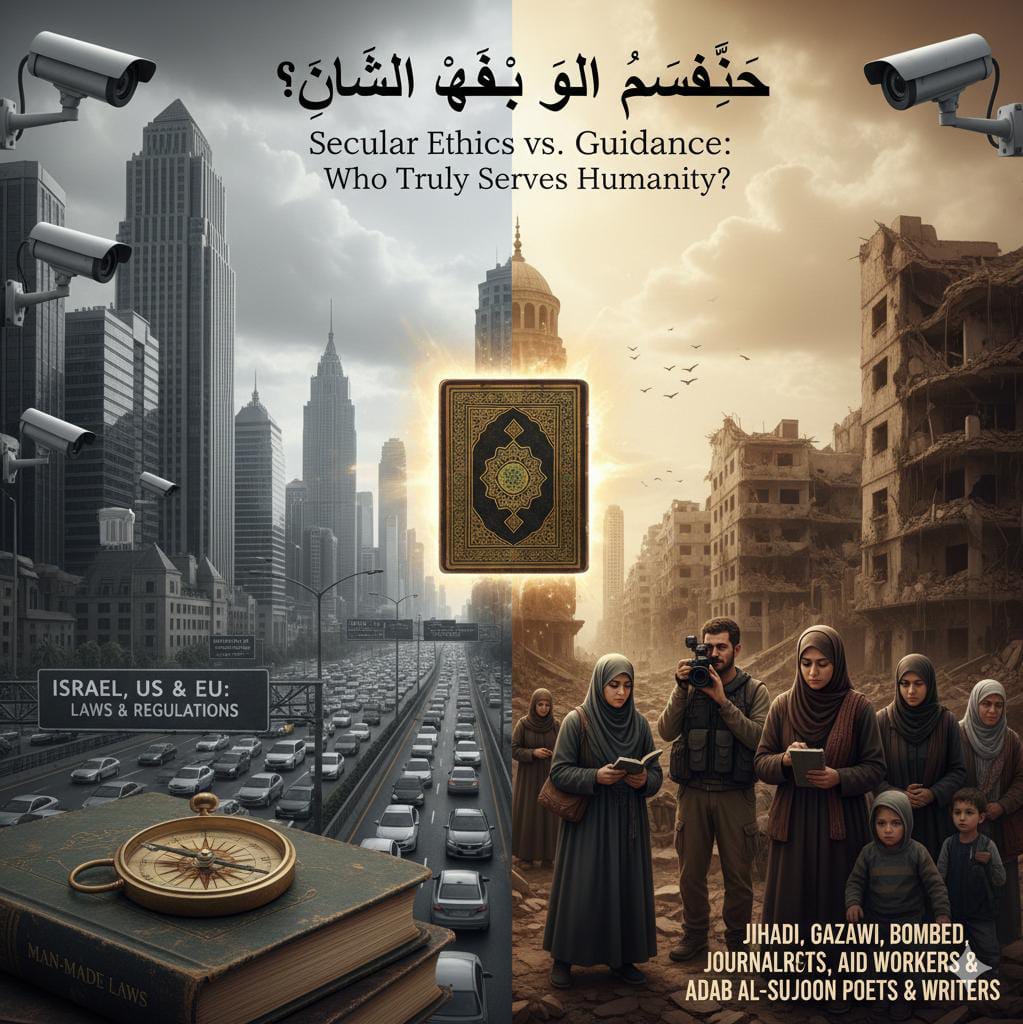
Israel, US, and EU / Jihadis, Gazans, the Bombarded, Journalists, Aid Workers, and the Poets & Writers of Prison Literature (Adab al-Sujoon)
Introduction
In today’s world, where we are surrounded by a web of laws, the crisis of morality is deepening by the day. Our legal books are growing thicker, but the moral books of our hearts are becoming emptier.
The question is:
Can mere laws or CCTV cameras truly make a person virtuous?
History bears witness that as long as there is no “Fear of God” in the human heart, man will always find loopholes in the law.
The Dialogue That Shook Many Hearts
Recently, a dialogue between Javed Akhtar and Mufti Shumail Nadwi created a unique situation.
This debate jolted countless “born Muslims” — those who inherited Islam as a legacy but never truly understood it. These were people who prayed in mosques but practiced usury in the marketplace; who fasted in Ramadan but ignored the rights of their neighbors.
This dialogue made them realize a powerful truth:
Islam is not merely a set of rituals, but a complete way of life.
The Question Is Not Just God’s Existence — But Obedience
Discussing the existence of God is one thing.
Obeying His revelation is quite another.
Our tragedy is that we claim to believe in God, yet we try to reshape His commands to fit our desires. We want God to follow our principles — instead of submitting ourselves to His.
Secularism: A “Flexible” Morality
Modern secularism has given us a morality that bends according to convenience.
- Utilitarianism says: “Whatever benefits the majority is moral.”
But if the majority crushes a minority, is that moral? - Deontology says: “Do your duty.”
But whose duty, and who defines it? - Egoism says: “Look after yourself first.”
All these systems are flawed because they are created by imperfect human minds. When the imperfect makes laws for the imperfect, injustice is inevitable.
Divine Guidance: Complete, Constant, and Flawless
Divine Guidance comes from the Creator of humanity — the One who knows our weaknesses, desires, and limits.
This moral code:
- Does not change with time
- Is not manipulated by power
- Is not distorted by politics
What was true fourteen hundred years ago is true today — and will remain true tomorrow.
Faith Without Accountability Is Hollow
For many, faith lasts only as long as comfort remains.
We pray so Allah will give us.
We do good so we can gain Paradise.
But true faith is:
- Being grateful in hardship
- Doing good without reward
- Standing firm when it costs you
Without belief in the Hereafter, morality becomes empty theater.
Practical Steps: Beginning Your Moral Journey
- Self-assessment:
Is your Islam ritualistic — or conscious? - Seek knowledge:
Revisit the dialogue between Javed Akhtar and Mufti Shumail Nadwi with reflection. - Make one change:
Remove one sin you know is wrong but still tolerate. - Reach out:
Talk about ethics and faith with your family and friends.
Final Word
It is easy to debate God.
It is hard to obey Him.
Because obedience requires:
- Humility
- Self-control
- The defeat of ego
But remember:
The One who created us knows what is best for us.
From today, align your moral compass with Divine Guidance. This is not only a religious obligation — it is the restoration of human nature itself.
May Allah grant us the strength to walk the straight path and make our deeds sincere for His pleasure. Ameen.