
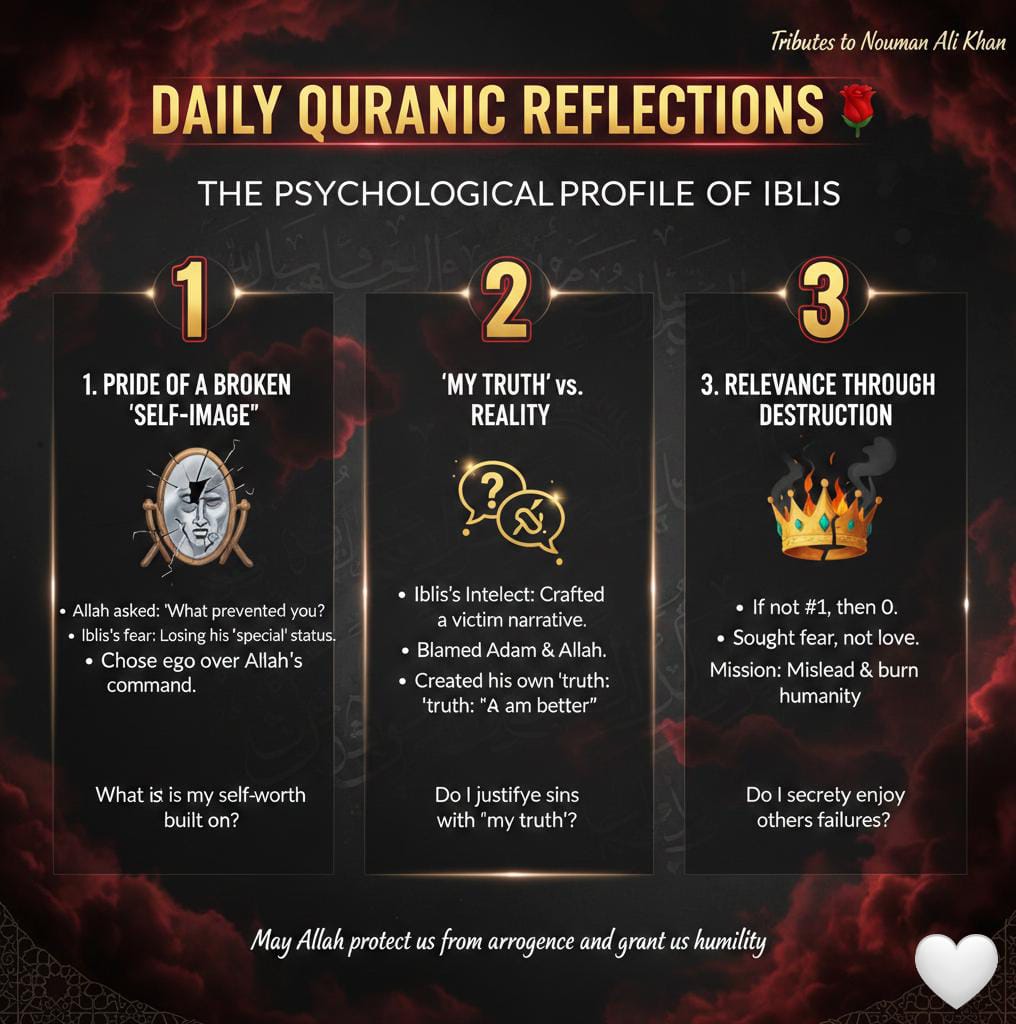
Lesson 1: The Pride of a Broken “Self-Image”
In Surah Al-A’raf, when Allah speaks to Iblis, a profound psychological secret is hidden within the framing of His question. Allah does not ask, “Why did you disobey Me?” Instead, He asks, “What prevented you?”
This subtle shift changes the entire narrative.
It suggests that Iblis was originally prepared to obey—he had the intention—but a psychological barrier suddenly rose within him. That barrier was his own constructed self-image.
Iblis had assigned himself a special status. Being the only jinn among angels, he believed his rank was due to his own merit. His identity was built on feeling unique and superior.
When Allah commanded him to prostrate to Adam (A.S.), this self-image was threatened.
He faced two choices:
- Break Allah’s command
- Or break his ego
He chose to protect his ego.
Nouman Ali Khan explains that Iblis feared losing his uniqueness—becoming “just like everyone else.” That fear became stronger than his fear of Allah.
Reflection
- What is my self-image built upon?
- Do I measure my worth through status, wealth, or comparison?
- Do I ever disobey truth just to protect my ego?
Lesson 2: “My Truth” vs. The Absolute Truth
The most dangerous trait of Iblis is not ignorance—it is misguided intelligence.
He fully believed in Allah. He understood the command. He knew the consequences. Yet, he still refused.
Why?
Because he created his own version of reality—his “personal truth.”
In his narrative:
- He was the victim
- Adam (A.S.) was the cause
- His position was unjustly threatened
He even blamed Allah:
“Because You have sent me astray…”
Then came his justification:
“I am better than him. You created me from fire and him from clay.”
Once this narrative settled in his mind, no truth could reach him anymore.
He no longer needed The Truth—because he had created his own.
This is the same trap Iblis sets for humans:
- Justify your sins
- Blame others
- Rewrite reality in your favor
Reflection
- Have I created stories to justify my wrong actions?
- Do I blame circumstances or people for my mistakes?
- Am I willing to abandon my truth for the Absolute Truth?
Lesson 3: The Desire for Relevance Through Destruction
After being expelled, Iblis lost his sense of worth.
In his mindset:
If I cannot be the best, I will be the worst.
Instead of choosing humility, he chose destruction as identity.
His mission became:
- Mislead humanity
- Stay relevant through chaos
- Ensure others fall with him
As beautifully explained:
He knows he will be punished, but he wants others to burn with him.
This is the peak of arrogance—a life driven by:
- Envy
- Resentment
- The need to pull others down
We see this pattern in the story of Yusuf (A.S.)’s brothers:
They created a false narrative, justified their jealousy, and were willing to throw their own brother into a well.
Reflection
- Do I feel satisfied when others fail?
- Do I compare myself to feel superior?
- Am I building something… or just reacting to my inner wounds?
Final Reflection
The story of Iblis is not just history—it is a psychological mirror.
It teaches us that downfall does not begin with disbelief—it begins with:
- Ego
- Justification
- Refusal to accept truth
Dua
May Allah protect us from the arrogance that whispers “I am better”,
and grant us the humility to bow before Him—
so that He may raise us in true honor.
Ameen.